
CO₂ Cannot Warm the Atmosphere or Earth
The CO₂ myth is dispelled using first semester principles, Part 1


“The climate has always changed, we just showed up recently” - TC.
Tuco’s Child Preface
In Part 1 of “CO₂ Cannot Warm the Atmosphere or Earth” we will share in simple of terms why a vanishingly small amount of CO₂ (400 ppm), that absorbs a sliver of far-infrared energy from the Earth’s black-body radiations, cannot heat the lower atmosphere or Earth.
Using a simple series of budget-like calculations, this article will show that there is not enough heat energy, derived from from CO₂ molecules absorption of Earth infrared emissions, to heat or raise the temperature of the atmosphere or Earth. The total heat energy that CO2 transfers to the surrounding air from the Earth’s black-body radiations registers as little more than a rounding error. The result is that CO2 has almost no effect on the temperature of the air and thus Earth.
This piece is written in the same spirit as a prior article describing why energy is not renewable and there is no such thing as renewable energy. We explained that the concept of renewable energy is in violation of the most basic laws of physics, including the First and Second Laws of Thermodynamics. That article can be found here:


The Earth Emits Infrared Energy and CO₂ Captures a Small Sliver
Heat is a familiar manifestation of energy. Heat energy flows spontaneously and irreversibly from hot to cold, whenever a difference in temperature exists, per the Second Law of Thermodynamics.
Temperature is a measure of heat energy. Heat energy arises from the oscillations, collisions and electronic excitations of atoms and molecules in gases, liquids and solids. The higher the frequency of these phenomena, the higher the energy is and more heat is generated.
The Sun radiates energy and heats the Earth. The Earth re-emits a portion back out to space in all directions. Some of the heat sent back to the atmosphere from the Earth makes molecules move, rotate, and in certain cases, vibrate. The energy from Earth’s radiation is distributed over many billions of molecules by collisions between each other, at about a billion times per second.
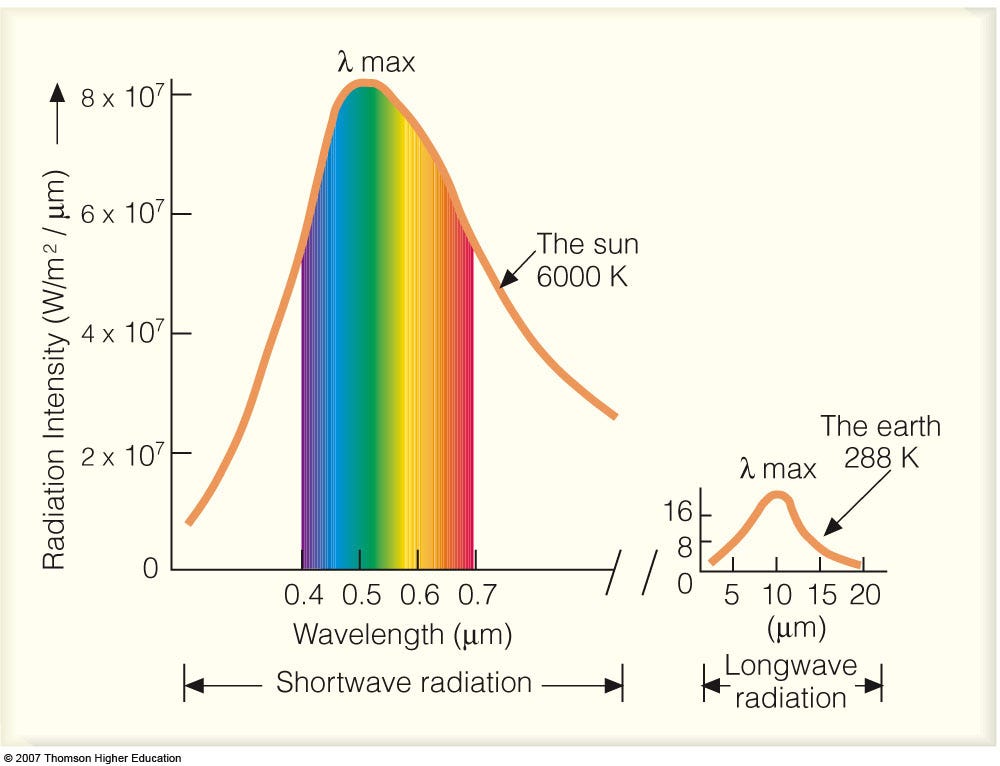
Above: The emission spectrum peak of the hot sun (6000 Kelvin, 0.48 micron peak wavelength) is compared to the longwave infrared radiation from the Earth (288 Kelvin,10 micron peak wavelength). The average surface temperature of Earth is about 15°C (59°F), which is 288 K in Kelvin. Note that the emission maximum (highest energy) is at 10 microns, and that the CO2 sliver is off to the side at 15 microns.
Please consider the 2 scales in the above graphic - the radiation intensity of the sun is about a million times more than what the Earth radiates back out to the atmosphere and space. A CO₂ molecule can absorb a small sliver of energy (a photon) from a small fraction of the Earth’s black-body emissions at the 15 micron wavelength, shown in the graphic above.
CO2 molecules do not radiate or emit photons in most of the troposphere. That is because the air is dense, and the CO2 molecules transfer their energy by collisions with oxygen and nitrogen (and some water) molecules, which comprise 99 % of all gases.
CO2 molecules only radiate or emit photons in the upper reaches of the atmosphere (70 km +) where the air density is low, and the collision rates become comparable to CO2 photon radiation rates. In this sense, CO2 is actually cooling the atmosphere, by releasing heat energy to outer space that it originally obtained from collisions with warmer gases “down below”.
The Total Kinetic Energy of the Air is a Result of Molecular Motions, Rotations and Vibrations
The total kinetic energy of atmospheric gases and thus temperature is a result of gas molecules motions, rotations and vibrations. Of the common gases found in the atmosphere, only CO2 and H2O vibrate at or around 288 K, the average temperature of the Earth’s black-body radiation. Oxygen and nitrogen, making of 99 % of all gases are not vibrationally active at 288 K, and only comprise translational and rotational kinetic energies. The animation below illustrates gas molecules with kinetic energy.

Above: air is mostly nitrogen, oxygen and water. As shown, excluding water, nitrogen and oxygen and some CO₂ molecules (red color) bounce around and collide with each other and exchange their kinetic energy at about 1 billion times per second.
Adding up CO2 Kinetic Energies for Comparison to the Whole Atmosphere
In the following sections we will explain in a step-wise fashion why total CO2 energies and those from absorbing Earth radiation at the 15 micron wavelength are not sufficient to warm the atmosphere or Earth. We will give CO2 the best-case scenario in this analysis, and ignore any inefficiencies or losses in the absorption and exchange of captured heat energy to rest of the atmosphere.
As mentioned prior, it is important to note that CO2 transfers it’s energy primarily by collisions, not photon emissions (radiant). CO2 infrared radiation (photons) only occurs in the thin upper reaches of the atmosphere where there are fewer molecules to collide with. In the analysis below, we will add up the kinetic energies and ultimately adjust the CO2 energy output by its actual concentration of 400 ppm (0.0004 fraction).
To start, the kinetic energies (KE) of a gas are scalar, or can be added together, so we will do that, per below:
KEtotal = KEtranslational + KErotational + KEvibrational
Importantly, gas kinetic energies KEtranslational + KErotational arise from their movements and rotations in space - objects in our 3D space have 6 degrees of translational and rotational freedom per the graphic below. This is an important concept in physics and mechanics, and is used to calculate total translational and rotational kinetic energies of a gas.
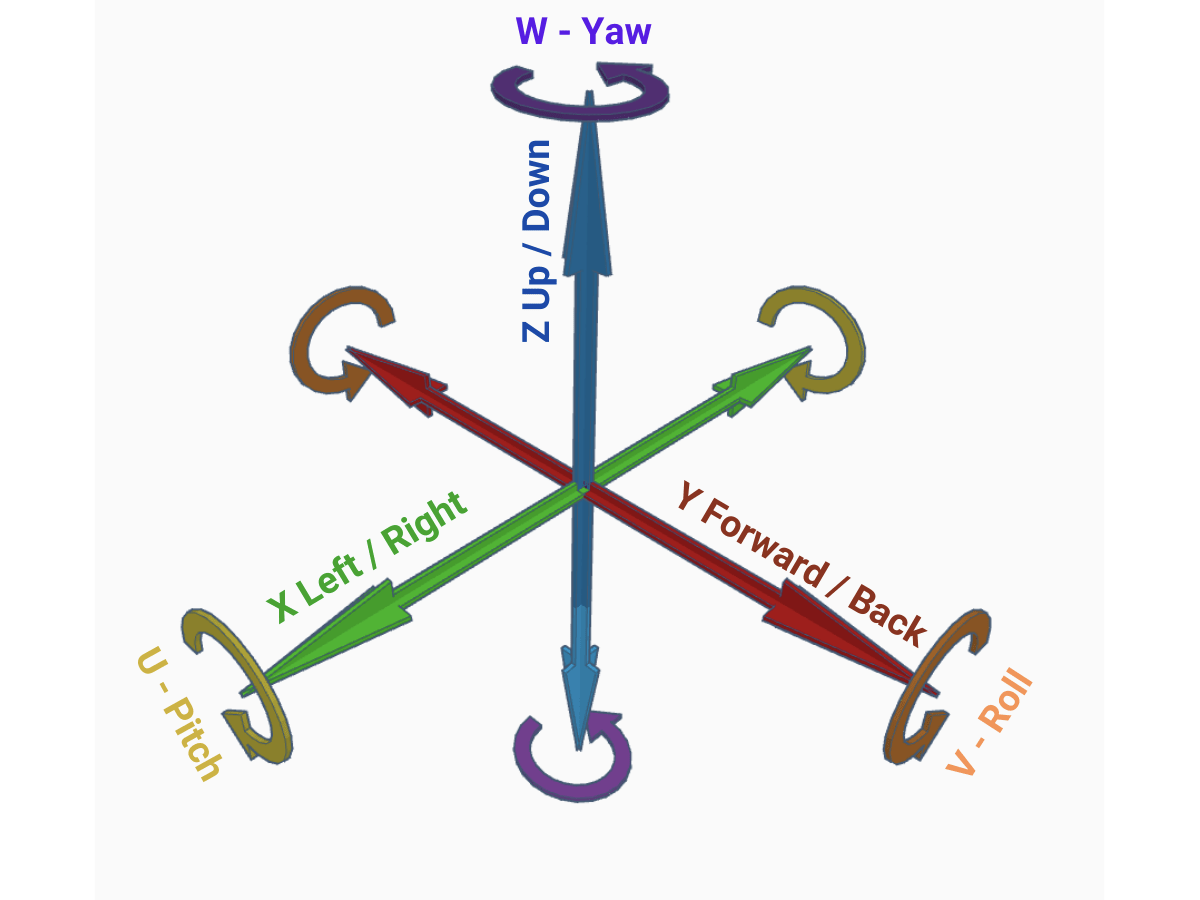
Above: translational and rotational - an object or air molecule can move along 3 axes and rotate around each axis. This is known as the 6 degrees of freedom. Not shown is the vibrational degrees of freedom (ways it can vibrate).
In addition to translational and rotational energies, we must add the CO2 vibrational energies (KEvibrational ) to obtain the sum total of CO2 kinetic energy. To visualize, we show an animation below of the bending vibration(s) of a CO2 molecule derived from capturing Earth’s long-wave 15 micron infrared emission.
Above: Shown are the two C=O bending modes that result from the absorption of Earth’s photonic infrared emission at the 15 micron wavelength. The CO2 bending modes can be thought of as a spring being compressed and then released. CO2 has 4 distinct ways it can vibrate from capturing Earthly infrared emissions, but the 15 micron wavelength bending mode dominates.
How-to: Calculating CO2 Energies for Comparison to the Total Atmosphere
First we start with the translational and rotational energies of CO2: the Kinetic Theory of Gases describes molecules in motion and the physical behaviors of dilute gases, which is a decent approximation of our atmosphere. Most specifically, the theory posits that gas molecules colliding with some velocity and momentum possess kinetic energy (KE = 1/2mv2). This can be related to temperature by the equation below, which includes KEtranslational + KErotational.
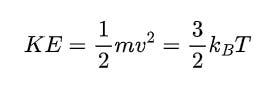
Above: the Kinetic Theory of Gases teaches that the average kinetic energy of gas molecules is directly related to the absolute temperature of the system. This relationship is expressed by the equation: KE=1.5kBT, where kB is the Boltzmann constant, T is temperature in Kelvin. The coefficient can change depending on all the movements or degrees of freedom of a particular molecule.
Next we solve for CO2 vibrational energy, to get a total CO2 kinetic energy: we can determine the CO2 vibrational energy absorbed from a 15 micron photon from the Earth’s black-body radiation. To calculate the gaseous CO2 vibrational energies, a different equation is needed, as derived from Einstein’s Quantum Oscillator Solid Model.
This sounds complicated, but it can be explained simply in terms of a simulated oscillating spring bounded by certain conditions that include a fixed temperature and thermal equilibrium with neighbor gases. The “vibrational quantum oscillator” equation combines the Boltzmann constant with the Plank-Einstein relation, as shown below:
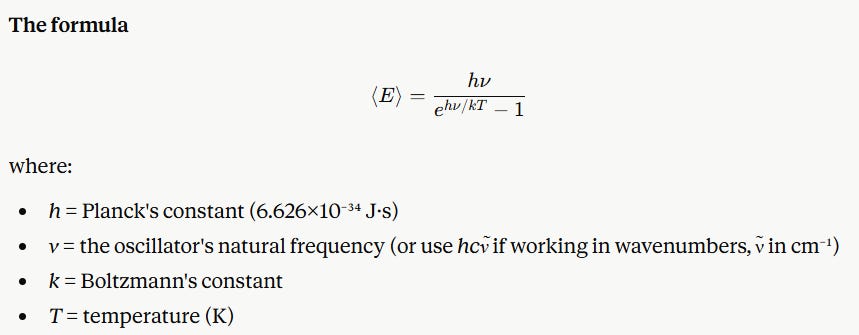
Above: CO2 theoretical vibrational energies can be derived from Einstein’s Solid Oscillator model and the equation above. It is important to remember that these are theoretical idealized numbers without attendant losses. There will be losses and waste heat in all collisions or energy transfers.
Part A: Results of the Kinetic Energy Showdown : O2 and N2 vs. CO2
Mano e mano, molecule to molecule, we compare total O2, N₂ and CO2 total kinetic energies at 288 K.
RESULTS
KEtotal diatomic O2 and N₂ (translational + rotational)
KE = (5/2)kT ≈ 9.91 × 10⁻²¹ J per molecule.
KEtotal linear triatomic CO₂ (translational + rotational + vibrational)
KE = (3/2)kT + 2/2kT + Einstein Oscillator and 2 bending modes ≈ 0.98 × 10⁻20 J per molecule.
Part A: Kinetic Energy Showdown Conclusions
The total kinetic energies for nitrogen, oxygen, and CO₂ at 288 K are are very close per Kinetic Theory and Boltzmann and Einstein: ≈ 1.0 × 10⁻20 J per molecule.
The CO2 vibrational energy from the 15 micron absorption does contribute a bit more energy to it’s total kinetic energy, but that is a tiny amount.
We have calculated separately that CO2 vibrational energy is about 5 % of it's total kinetic energy at 288 K. This number is very small because there is not sufficient thermal energy at 288 K to boost or excite CO2 to the 15 micron bending modes excited state(s).
So what is the total % kinetic energy contribution of CO2 adjusted for it’s 400 ppm concentration ?

Part B. Results of the Kinetic Energy Showdown: 400 ppm CO2 vs. 99 % N2 and O2
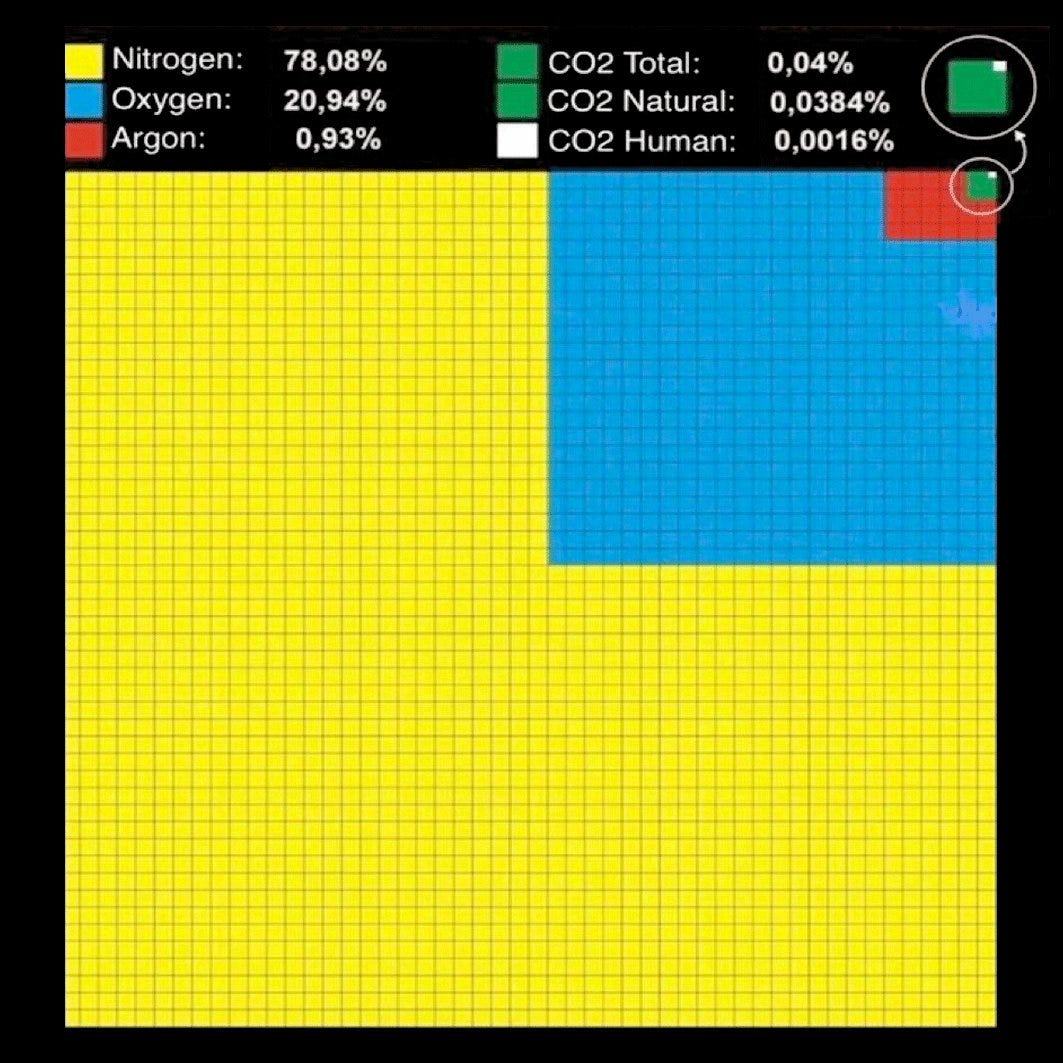
CO₂ is a trace gas at about 400 ppm (0.04 %) or 400 molecules in 1,000,000. In the graphic, note the contribution of “human-made” CO₂, orders of magnitude less than “natural” CO₂. For simplicity sake, water is excluded in the graphic.
Where the Rubber Meets the Road, the 0.0004 (0.04 %) Factor. We learned that common atmospheric gases have close to the same kinetic energies at a given temperature. The kinetic energy can vary in subtle ways depending on molecule structure, mass, and the it’s modes of absorbing and giving off energy.
The amount of a given gas in the atmosphere is obviously a critical factor. Given that, lets now calculate how much energy 400 ppm of CO2 trace gas can add to the atmosphere, which is already 99% N2 and O2 with some water thrown in.
We ignore the water kinetic energies contribution only for now - it is substantial, and will swamp out trace CO2 - a subject to be covered in Part 2 of “CO₂ Cannot Warm the Atmosphere or Earth”.
The % Fraction of CO2 Kinetic Energy in the Entire Atmosphere
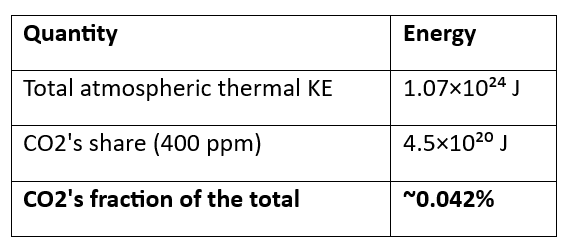
Above table shows the CO2 % fraction of kinetic energy in the entire atmosphere at 288 K. N2 & O2 only, water excluded for simplicity. These calculations show that the atmosphere has about 4 powers of 10 greater kinetic energy than CO2 at 288 K.
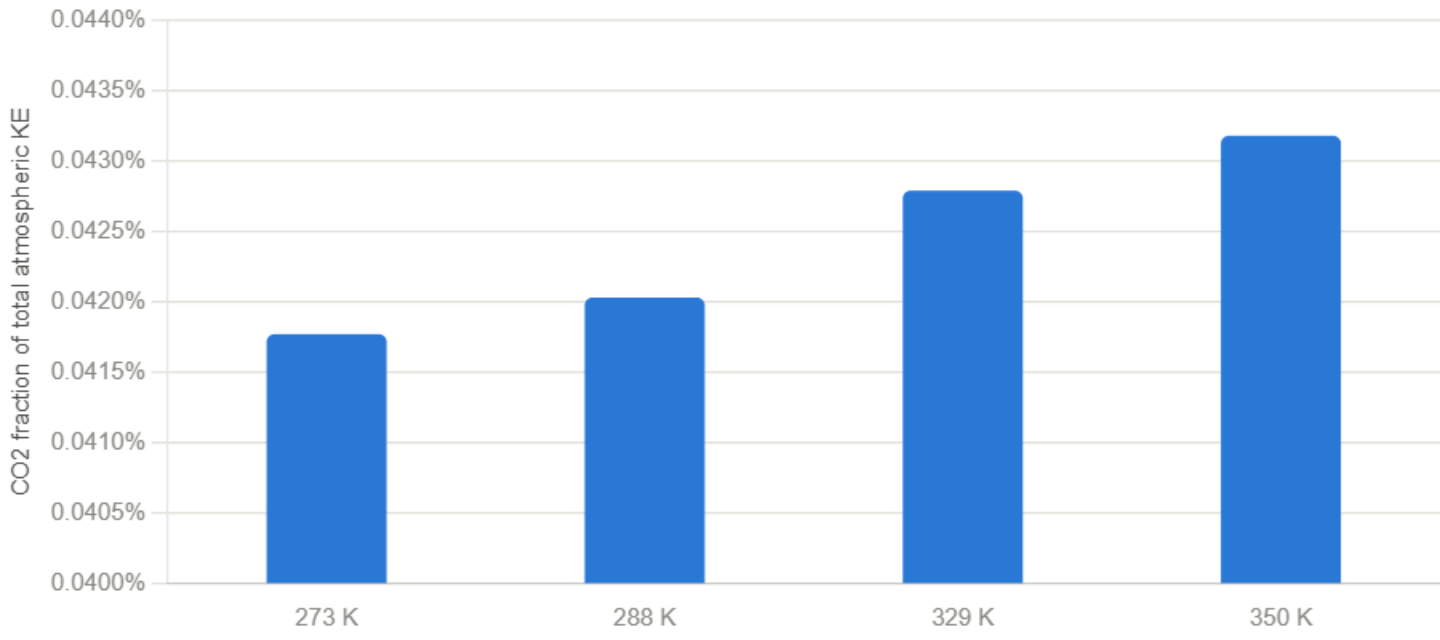
Above is a plot of CO₂'s kinetic energy at various temperatures compared to rest of the atmosphere (N2 & O2, water excluded for simplicity). As temperature increases, more excited states are populated per Boltzmann. One can see that CO₂’s energy contributions to the atmosphere are vanishingly small, and is more in the realm of a rounding error. If we included water, which has a high heat capacity, the CO2 numbers would be less.
Part B. Kinetic Energy Showdown Conclusions: 400 ppm CO2 vs. N2 and O2
There simply aren't enough CO₂ molecules for it’s total energy to register as more than a rounding error in the total kinetic energy of the air for temperatures that range from 273 K (0o centigrade, freezing) to 350 K (77o centigrade) and beyond.
CO2 kinetic energy in the graph increases at temperature as more vibrational states are populated (coiled springs that release kinetic energy). CO2 molecules translational and rotational energies track with N2 and O2, and only add small amounts of vibrational energy as the temperature increases. - not enough to make a difference.
Note that the number 0.04 % keeps appearing. This is no mistake. 400 molecules in a million is related to the mole fraction/number of CO2 molecules in the atmosphere. This is a check on the goodness of the calculations running in the background as well.
Final Conclusions
We have shown in the most simple terms that CO2 emits a vanishingly small fraction of infrared energy originally captured from the sun. That amount of energy is about 0.04 % of the atmospheres total kinetic energy at 288 K (and the same at higher temperatures at 2 significant figures).
There is nothing special or catalytic about CO2 where it would have some exceptional non-linear effect on heat or energy transfer so as to raise the temperature of adjacent molecules in a measurable way.
CO2 absorbs at 15 microns and re-emits at lesser energies due to waste heat losses from inelastic collisions with near neighbors at about a billion times per second.
Any excited vibrational states of CO2 are almost instantly depopulated by kinetic energy transfer to neighboring nitrogen and oxygen molecules at about 1 billion collisions per second. The collisional rate is far greater the the excited state lifetime of CO2, so there is a vanishingly small chance that a photon is emitted.
The CO2 vibrational energies are thus dissipated into the massive pool of oxygen and nitrogen molecules by imperfect inelastic collisions and collisional losses at a out a billion times per second. At 288 K only about 5 % of CO2 vibrational state are excited by the due to the 15 micron absorption.
CO2 molecules mostly radiate or emit photons in the upper reaches of the atmosphere (70 km +) where the air density is low, and the collision rates become comparable to CO2 photon radiation rates. In this sense, CO2 is actually cooling the atmosphere, by releasing heat energy to outer space that it originally obtained from collisions with warm gases “down below”.
The Earth is an open dynamic system with an atmosphere held in by gravity but with exposure to a very cold outer space and vacuum. The atmosphere has great variations in temperature, pressure, and thermal energies, including those over different types of matter such as water and land, notwithstanding air currents and albedo effects. These phenomena cause great uncertainty in climate models and the actual role of CO2.
Given the above, it is the opinions of the authors that most climate change models are terminally defective or DOA. There simply aren’t enough CO₂ molecules for it’s vibrational energy or total kinetic energy to register as more than a rounding error in the total kinetic energy of the air for temperatures that range from 273 K (0 centigrade, freezing) to 350 K (77 centigrade). There are far greater forces in play here, such as water, clouds, sand air circulation.
Tuco’s Child Note: Calculations performed manually, via Claude.ai and Thermal Energy Calculator. Contact Tuco’s Child for more details on these calculations.
Addendum
A Note about Water

We will present our water data and calculations in Part 2. We do preview here that water is a substance that drives our climate. We note that water displays three distinct phases at typical Earth temperatures: solid ice, liquid, and gas. The three phases have different heat capacities and each phase plays a unique role in the Earth’s temperature regulation and energy balance.
Further, and in contrast to CO2, the average water concentration in the atmosphere is far greater, and critically, water has significant infrared absorption bands, the most important at the 6.3 micron wavelength. This strongly suggests that H₂O can absorb and emit substantive heat and may control the heat in and out of the atmosphere.
Air Heat Transfer, The Two Different Types
1) Conduction and convection: the primary way N2 and O2 gain kinetic energy, not from CO2
This is heat transfer that requires matter — atoms or molecules bumping into each other and passing energy along.
Conduction from the surface: N₂ and O2 molecules near the ground physically collide with the sun-warmed surface (dirt, rocks, ocean) and pick up kinetic energy directly through molecular collisions.
Convection: as warm air near the surface rises, N₂ and O2 molecules are carried along, mixing with cooler air above — this is bulk fluid motion, not molecule-by-molecule energy transfer, but it redistributes the kinetic energy nitrogen has.
Both above require a physical medium or matter to be involved.
2) Radiant energy (radiation)
This is heat transferred via electromagnetic waves — mostly infrared radiation — no matter or substance.
Any object above absolute zero radiates some infrared energy just by virtue of its temperature — this is how thermal cameras “see” heat.
When radiant energy hits an object, it gets absorbed and converted into molecular kinetic energy (vibration) — which is why standing near a fire warms you even without touching the flame or the air directly next to it.




 | A guest post by
|
 | A guest post by
|
 | A guest post by
|
 | A guest post by
|
Excellent analysis. Another question to consider is, "How does a greenhouse function?" The transparent panes allow the sun's energy to enter. However, the panes prevent mixing with the adjacent atmosphere and limit the escaoe of the water vapor that is produced when the sun's energy vaporizes the water inside the greenhouse. As a result, the temperature inside the greenhouse rises. The water vapor concentration rises inside the greenhouse. Carbon dioxide in our atmosphere does not possess the capabilities of a greenhouse. My conclusion is the claims regarding carbon dioxide are not scientific - the claims regarding carbon dioxide are propaganda.
Great discussion. This will be beyond the capability of many to understand. Those people need to just accept the conclusions of real science and reject the fake science and charlatans promoting the climate cult. This is the challenge. We need to stop funding the climatocatastrophists funding for studies with predetermined conclusions supportive of climate cult ideals.